



USA : Uncovering CA labor
American labor unions are often associated with New York City garment workers or
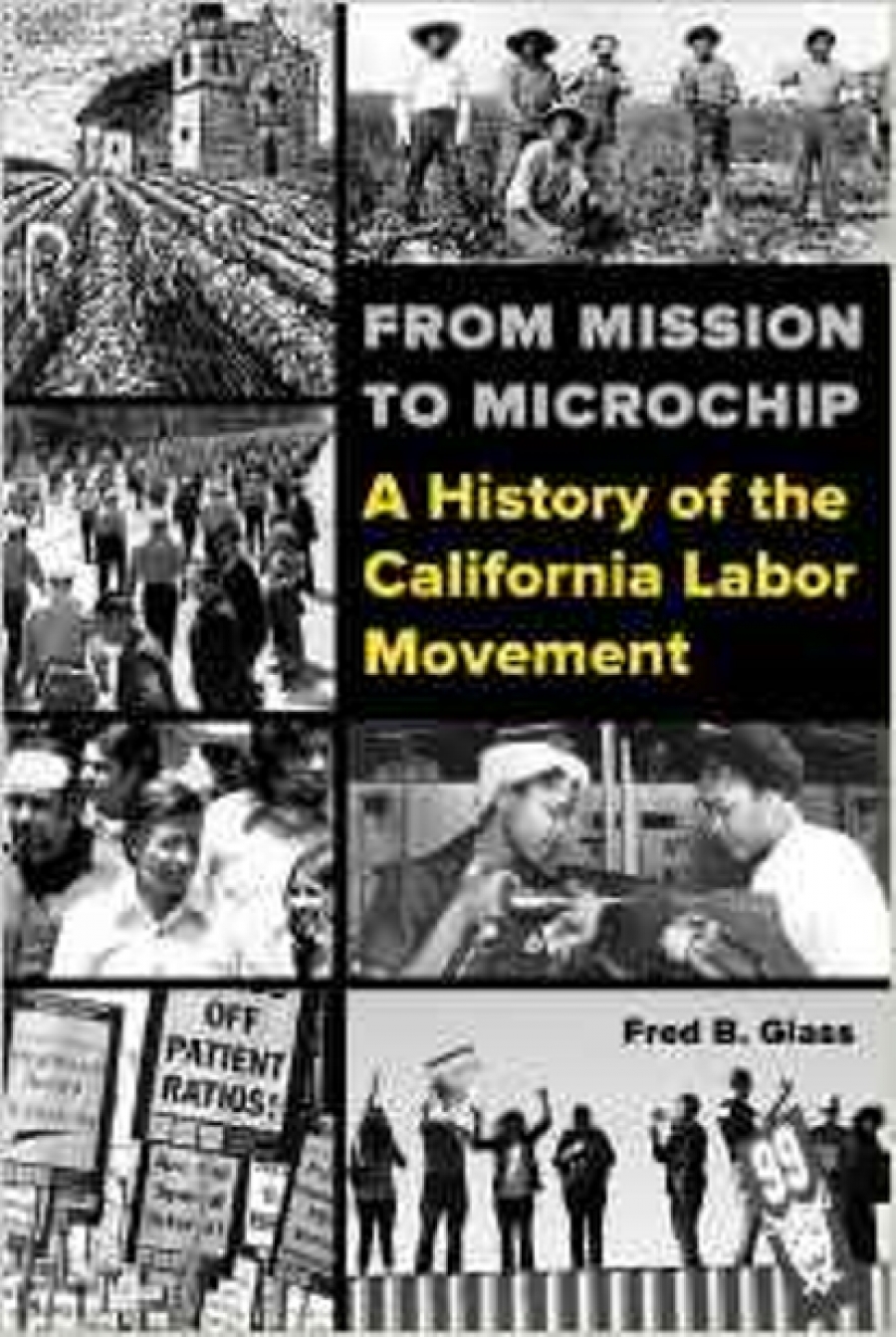
West Virginia coal miners, but California has a rich labor history. Fred Glass’ brilliant new book, From Mission to Microchip: A History of the California Labor Movement, explores labor’s legacy, firmly situating the labor movement in the state’s broader social and political context. Glass, Communications Director for the California Federation of Teachers (CFT), offers a powerful reinterpretation of the state’s political trends over the past fifty years. His book is a worthy successor to Peter Schrag’s 1998 Paradise Lost: California’s Experience, America’s Future in its fresh analysis of politics in the Golden State.
The Pre-New Deal Era
Glass spends the first quarter of the book on the pre-New Deal, pre-National Labor Relations Act era. This sets the context for labor’s advances once the right to organize was legally protected. Fans of San Francisco history will enjoy Glass’ account of labor’s early political success, which reached a high point when Musicians Union President Eugene Schmitz was elected mayor in 1902 and re-elected in 1905.
Glass also discusses farm laborers at the start of the 20th century. Their struggles would prove a forerunner of Cesar Chavez’s campaign for a farmworkers movement and the rise of the UFW. Agricultural labor is too often ignored in accounts of the early American labor movement, but California was an agrarian state. Glass shows how the early ethnic alliances formed in the fields were repeated decades later.
The book really takes off in the activist frenzy of the 1930’s. Glass vividly recounts San Francisco’s 1934 general strike, particularly the role of ILWU President Harry Bridges and the young Sailors Union activist Harry Lundeberg. A West Coast longshore strike precipitated the general strike, and Glass describes how the maritime workers “changed the fundamental nature of their relationship with the bosses.”
Glass also highlights how the CIO’s rise in the 1930’s brought industrial workers and immigrants into the California labor movement. Furniture workers in Los Angeles, oil workers in the San Joaquin Valley, and garment workers in San Francisco’s Chinatown were now part of progressive labor alliance with auto and steel workers across the nation. The CIO forced the rival AFL to invest more resources in organizing, and offered workers a staunchly progressive labor political vehicle otherwise lacking.
Labor’s Rise in the 1940’s
World War II expanded America’s industrial base, leading to an explosion of union jobs in defense plants. 80% of California’s industrial workforce was in shipbuilding and aircraft production, with the Bay Area doing most of the former and Southern California the latter. Although workers who had suffered under the Depression were eager to regain lost income, labor militancy during the war was restricted by a “no strike” edict. This changed in 1945-6, paving the way for the nation’s largest wave of strikes in history. Among them was a 1946 general strike in Oakland, which I was unaware of until reading this book.
Oakland’s strike emerged from a labor dispute at two clothing stores, Kahn’s and Hastings, by Retail Clerks Local 1265. The strike continued for over a month, as workers got support from the Alameda County Labor Council and from Teamsters drivers who refused to deliver goods to the stores. Oakland officials then enlisted strikebreakers, who were joined by hundreds of Oakland police using their publicly funded jobs to break the picket lines through violence against strikers. This violence, coupled with the illegal use of public employees as strikebreakers, led to the Oakland general strike.
It’s a powerful story that Glass has reclaimed for today’s world. He brings back many gripping stories of labor activism throughout California history, which is why much of the book reads like a page-turning novel.
Glass also highlights the pervasive racial discrimination within many unions during these years of rising membership. Some unions, like the Boilermakers, had segregated locals, and when forced to end this practice figured out new ways to stop African-American union members from getting work. Pervasive racial discrimination in some unions would continue into the 1970’s, getting more esoteric with reliance on seniority and other “objective” criteria whose impact was to hurt blacks.
1950’s Backlash
Unfortunately, the postwar rise in worker gains and militancy was soon followed by a backlash. Glass shows this pattern of labor success followed by backlash continuing to the present, and in 1947 it took the form of the federal Taft-Hartley Act and use of anti-communism to destroy progressive unions.
California’s labor movement was particularly hurt by the post war Red Scare, as Hollywood became a chief target. The recent film Trumbo showed what happened to the Hollywood Ten, among the many blacklisted for refusing to name names. Hollywood unions were decimated by the anti-communist purges, and the entire California labor movement saw a weakening of its most progressive and activist voices.
Glass might have included the sad saga of the California Labor School, which operated at 240 Golden Gate in San Francisco’s Tenderloin. The Labor School was the leading force of its time connecting workers to arts and culture. Its teachers included Paul Robeson, Frank Lloyd Wright, and Pete Seeger, and muralists such as Anton Refregier and Bernard Zakheim. Over 5000 workers attended classes. But the IRS accused some of its lecturers of being Communists and revoked the School’s tax exempt status. It closed in 1951 and nothing like it has since emerged.
Labor did win a big political victory in electing Pat Brown as Governor over the anti-union William Knowland in the 1958 election. Knowland not only led the effort to use police as strikebreakers in the 1946 Oakland strike, but was sponsoring a “right to work” state ballot measure to coincide with his governor’s campaign. Labor mobilized to defeat both Knowland and the right to work initiative, and won on both. California had not elected a Democratic Governor since 1938, and Brown soon signed labor’s top legislative priority: a Fair Employment Practices Act to stop racial discrimination in hiring.
Labor Becomes “Middle-Class”
Glass observes that as labor’s power grew along with the California economy, the “sense of need for social justice” was less “woven into the fabric of daily life. Working families could now buy homes, and pursue dreams in Disneyland’s Tomorrowland.
But some groups were left out of this prosperity, and their struggles shaped the California labor movement. This group included farmworkers, excluded from the 1935 federal National Labor Relations Act. And janitors, victimized by a shift in ownership strategies that left them employed by shifting management companies which—until SEIU’s Justice for Janitors—made them harder to organize.
But the biggest group excluded from this prosperity was public employees, including teachers. Glass shows how in the 1950’s the California Teachers Association (CTA) was basically a company union while the radical CFT was the entity pushing for collective bargaining for teachers. The process of how these two groups developed is likely unknown to most Californians, yet it speaks volumes to how public employees went from having no union rights to representing a far higher percentage of workers today than in the private sector.
1970’s to Today
The last section of the book offers a perceptive analysis of how California labor lost political support, and what it has done to regain it. Glass does not ignore labor’s self-caused errors (though his exclusion of the SEIU-UHW v. NUHW battle may peeve some readers), and makes an incontrovertible case that when labor is doing well in Sacramento, so are the vast majority of Californians.
That is really the dominant message of Glass’s book. Glass goes beyond the popular bumper sticker about how labor unions brought us the weekend and conclusively demonstrates how on progressive issue after issue, labor is fighting to benefit most Californians. Meanwhile, labor’s opposition is invariably wealthy and powerful special interests.
That Californians recognize this critical point is why Glass’ book needs to be read by the broader society and not just labor members or activists. Certainly everyone involved in any sector of California politics should read Glass’s analysis.
In a week which saw the UFW win a big legislative victory for farmworker overtime, Fred Glass has issued a powerful “Si Se Puede” for social and economic justice. California has become a shining example of how progressive worker policies are joined with economic growth, and Glass’ book shows how labor helped make this happen.
Randy Shaw has written about the labor movement’s longtime San Francisco base in The Tenderloin: Sex, Crime and Resistance in the Heart of San Francisco. He also writes about the labor movement in Beyond The Fields: Cesar Chavez, the UFW and the Struggle for Justice in the 21st Century,
Contributor

Randy Shaw
Randy Shaw is the Editor of Beyond Chron and the Director of San Francisco’s Tenderloin Housing Clinic, which publishes Beyond Chron. Shaw is the author of four books on activism, including The Activist's Handbook: Winning Social Change in the 21st Century, and Beyond the Fields: Cesar Chavez, the UFW and the Struggle for Justice in the 21st Century. His new book is The Tenderloin: Sex, Crime and Resistance in the Heart of San Francisco
Tags: California, California Labor School, CFT, CTA, Labor Unions, San Francisco, Tenderloin, UFW
Filed under: Book Reviews