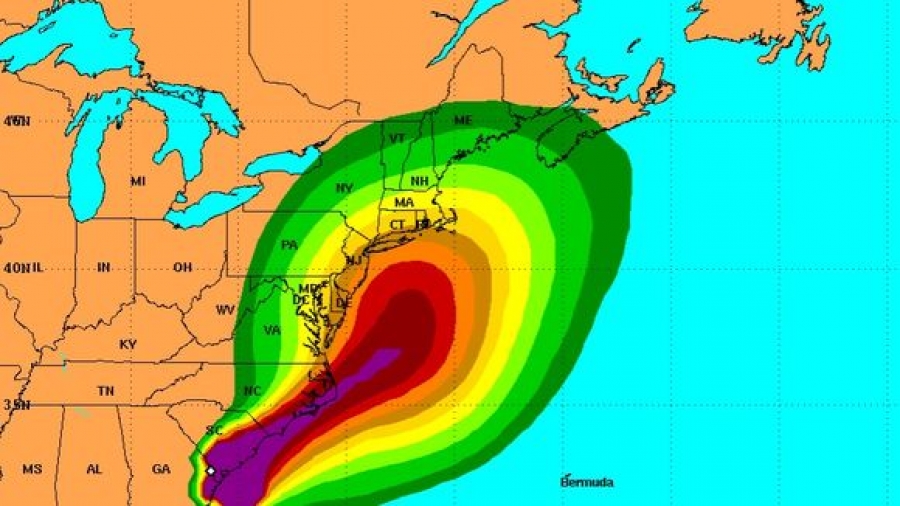
their change-fee waivers as the remnants of what was Hurricane Hermine continued to move inland over the Southeast and toward the Northeast.
Most of nation’s biggest carriers – including America, Delta, United, Southwest – had issued flexible rebooking policies earlier this week. But several of those airlines have gradually been expanding the number of cities and the dates included in their waivers.
Some airlines' waivers now extend as far north as Boston. Multiple carriers' have also moved to include the New York City and Washington/Baltimore airports in their waivers.
The policies vary by airline, generally allowing passengers ticketed to affected airports to make one change to their itineraries without paying the standard change fees. Such fees typically cost $200 for domestic itineraries and more for international ones.
FLIGHT TRACKER: Is your flight on time?
Several airlines also had waivers in place for Hawaii, which also was under a hurricane threat this week.
Scroll down for the basic details of the airline waivers in place for Florida and the Southeast as of 7 p.m. ET on Friday. Be sure to click on the fine print for more details.
Alaska Airlines
See more: Info on Hawaii waivers
American Airlines
Covers fliers ticketed to fly on the following dates: Varies by region
Cities covered (Sept. 1-3): Augusta, Ga.; Charleston, S.C.; Charlotte, N.C.; Columbia, S.C.; Destin/Fort Walton Beach, Fla.; Fayetteville, N.C.; Florence, S.C.; Gainesville, Fla.; Greensboro, N.C.; Hilton Head, S.C.; Jacksonville, Fla.; Myrtle Beach, S.C.; Pensacola, Fla.; Raleigh/Durham; Sarasota, Fla.; Savannah, Ga.; Tallahassee, Fla.; Tampa; Wilmington, N.C.
Cities covered (Sept. 3-4): Greenville, N.C.; Jacksonville/Onslow, N.C.; New Bern, N.C; Newport News, Va.; Norfolk, Va.; Richmond, Va.; Salisbury, Md.
Cities covered (Sept. 4-5): Long Island/Islip, N.Y.; New Haven, Conn.; New York JFK; New York LaGuardia; Newark Liberty; Westchester County/White Plains, N.Y.
Waiver highlight: Change fee waived for fliers changing their flight to a date between Aug. 31 and Sept. 6 for the first set of cities. For the second and third sets, flights can be changed to Sept. 2-8.
More info: American Airlines
See more: Info on Hawaii waivers
Delta Air Lines
Covers fliers ticketed to fly on the following dates: Sept. 1-3
Cities covered (Sept. 1-3): Brunswick, Ga.; Charleston, S.C.; Destin/Fort Walton Beach, Fla.; Gainesville, Fla.; Jacksonville, Fla.; Myrtle Beach, S.C.; Panama City, Fla.; Sarasota, Fla.; Savannah, Ga.; Tallahassee, Fla.; Tampa; Valdosta, Ga.; and Wilmington, N.C.
Cities covered (Sept. 4-5): New York JFK; New York LaGuardia; Newark Liberty; Newburgh/Stewart, N.Y.; Westchester County/White Plains, N.Y.
Waiver highlight: Change fee waived for fliers changing their flight to a date before Sept. 6 for the first set of cities. For the second set, flights can be changed to no later than Sept. 2. For travel beyond those date, customers can apply the value of their current tickets toward new ones without paying the standard change fee.
More info: Delta Air Lines
See more: Info on Hawaii waivers
JetBlue
Covers fliers ticketed to fly on the following dates: Sept. 1-5, though precise dates vary by city
Cities covered: Baltimore; Boston; Charleston, S.C.; Daytona Beach, Fla.; Fort Myers, Fla.; Jacksonville, Fla; New York JFK; New York LaGuardia; Newark Liberty; Orlando; Raleigh/Durham; Richmond, Va.; Sarasota, Fla.; Savannah, Ga.; Tampa; Washington Dulles; Washington National.
Waiver highlight: Change fee waived for fliers changing their flight to a date before Sept. 9.
More info: JetBlue
Silver Airways
Covers fliers ticketed to fly on the following dates: Sept. 1-2
Routes covered: Tampa-Tallahassee; Fort Lauderdale-Tallahassee; Tampa-Pensacola; Orlando-Pensacola; Tampa-Jacksonville.
Waiver highlight: Change fee waived for fliers changing their flights to a date before Nov. 15.
More info: Silver Airways
Southwest Airlines
Covers fliers ticketed to fly on the following dates: Varies by city
Cities covered (Aug. 31-Sept. 3): Charleston, S.C; Fort Myers, Fla.; Jacksonville, Fla.; Orlando; Panama City, Fla.; Tampa
Cities covered (Sept. 3-4): Baltimore; Boston; Long Island/Islip, N.Y.; New York LaGuardia; Newark Liberty; Norfolk, Va.; Philadelphia; Raleigh/Durham; Richmond, Va.; Washington Dulles; Washington National.
Waiver highlight: Southwest never charges a change fee. The airline will allow customers ticketed during the eligible dates to reschedule their flights within two weeks of the original travel date without paying a difference in fare.
More info: Southwest Airlines
Spirit Airlines
Covers fliers ticketed to fly on the following dates: Varies by city
Cities covered: Tampa (Sept. 1) and Myrtle Beach, S.C. (Sept. 2-3)
Waiver highlight: Change fee waived for fliers changing their flights to a date between Aug. 31 and Sept. 7. For travel beyond Sept. 7, customers may be able to apply the value of their current tickets toward new ones without paying the standard change fee.
More info: Spirit Airlines
United Airlines
Covers fliers ticketed to fly on the following dates: Sept. 1-3
Cities covered: Charleston, S.C.; Charlotte; Columbia, S.C.; Destin/Fort Walton Beach, Fla.; Fayetteville, N.C.; Jacksonville, Fla.; Myrtle Beach, S.C.; Panama City, Fla.; Pensacola, Fla.; Raleigh/Durham; Savannah, Ga.; Tampa.
Waiver highlight: Change fee waived for fliers changing their flight to a date before Sept. 7.
More info: United
See more: Info on Hawaii waivers
Virgin America
See more: Info on Hawaii waivers
TWITTER: You can follow me at twitter.com/TodayInTheSky
Aboard NASA's DC-8 flying laboratory
Posted!
A link has been posted to your Facebook feed.

Based at scenic Lake Quinalt in Washington State, a mobile doppler radar truck rests on a sunny day in support of NASA's OLYMPEX weather program on Nov. 22, 2015. Jeremy Dwyer-Lindgren for USA TODAY
![A 60-ton S-Band dual-polarimetric radar dish quietly]()
A 60-ton S-Band dual-polarimetric radar dish quietly scans the skies overlooking the Washington coast in support of NASA's OLYMPEX weather program on Nov. 22, 2015, near Moclips, Wash. Jeremy Dwyer-Lindgren for USA TODAY
![NASA's rare Douglas DC-8 aircraft rests on the tarmac]()
NASA's rare Douglas DC-8 aircraft rests on the tarmac at Joint Base Lewis-McChord in Washington on Dec. 5, 2015. Jeremy Dwyer-Lindgren for USA TODAY
![Technicians prepare to run early morning tests on NASA's]()
Technicians prepare to run early morning tests on NASA's ER2 research aircraft at Joint Base Lewis-McChord on Dec. 5, 2015. The ultra-rare airplane is seldom seen. Jeremy Dwyer-Lindgren for USA TODAY
![NASA Operations engineer Roosevelt Williams begins]()
NASA Operations engineer Roosevelt Williams begins his morning routine onboard NASA's DC-8 in preparation for a flight on Dec. 5, 2015. Jeremy Dwyer-Lindgren for USA TODAY
![NASA scientist Steve Durden, with the agency's Jet]()
NASA scientist Steve Durden, with the agency's Jet Propulsion Laboratory, checks instruments in the cargo hold of a DC-8 jetliner before a flight on Dec. 5, 2015. Jeremy Dwyer-Lindgren for USA TODAY
![NASA scientists Steve Durden, left, and Svetla Hristova-Vleva]()
NASA scientists Steve Durden, left, and Svetla Hristova-Vleva monitor equipment during a research flight aboard a modified Douglas DC-8 on a flight over the Pacific Northwest on Dec. 5, 2015. Jeremy Dwyer-Lindgren for USA TODAY
![NASA's Douglas DC-8 flying laboratory is devoid of]()
NASA's Douglas DC-8 flying laboratory is devoid of most creature comforts, save for a few restrooms, a cooler chest and a microwave/coffee maker, seen during a research flight over the Pacific Northwest on Dec. 5, 2015. Jeremy Dwyer-Lindgren for USA TODAY
![NASA safety technician Donald Bailes keeps watch over]()
NASA safety technician Donald Bailes keeps watch over equipment during a five-hour test flight aboard a modified Douglas DC-8 jetliner on Dec. 5, 2015. Jeremy Dwyer-Lindgren for USA TODAY
![Stars streak slightly in the pre-dawn sky as NASA's]()
Stars streak slightly in the pre-dawn sky as NASA's DC-8 flying laboratory cruises over western Washington State during a flight on Dec. 5, 2015. Jeremy Dwyer-Lindgren for USA TODAY
![Light creeps into the sky as NASA's DC-8 flying laboratory]()
Light creeps into the sky as NASA's DC-8 flying laboratory cruises over western Washington State during a flight on Dec. 5, 2015. Jeremy Dwyer-Lindgren for USA TODAY
![Pilots aboard NASA's modified Douglas DC-8 flying laboratory]()
Pilots aboard NASA's Douglas DC-8 flying laboratory guide the jet over the Pacific Northwest during a test flight on Dec. 5, 2015. Jeremy Dwyer-Lindgren for USA TODAY
![The giant windows aboard NASA's Douglas DC-8 distinguish]()
The giant windows aboard NASA's Douglas DC-8 distinguish it, easily, from most other jets flying today. Jeremy Dwyer-Lindgren for USA TODAY
![NASA safety technician Terrance Dilworth rifles through]()
NASA safety technician Terrance Dilworth rifles through an overhead bin full of manuals for the onboard equipment during a research flight aboard a modified DC-8 jetliner on Dec. 5, 2015. Jeremy Dwyer-Lindgren for USA TODAY
![Scientists Rachael Kroodsma, left, and Shamila Padmanabhan]()
Scientists Rachael Kroodsma, left, and Shamila Padmanabhan talk shop during a research flight aboard NASA's Douglas DC-8 flying laboratory on Dec. 5, 2015. Jeremy Dwyer-Lindgren for USA TODAY
Like this topic? You may also like these photo galleries:
Autoplay
Show Thumbnails
Show Captions
Last SlideNext Slide
Behind the scenes: NASA scientists take flight in Pacific Northwest
Posted!
A link has been posted to your Facebook feed.

NASA recently chose the Pacific Northwest as an ideal location to validate and refine data collected by the global precipitation measurement (GPM) satellite launched in 2014. The project is called the Olympic Mountain Experiment, or OLYMPEX. Jeremy Dwyer-Lindgren for USA TODAY
![The high-tech weather satellite, considered the most]()
The high-tech weather satellite, considered the most advanced ever flown, is able to quantify rain and snowfall around the globe with an eye toward eventually providing data from under-equipped areas such as the ocean and remote swaths of land. NASA
![With its trademark temperate rainforests glistening]()
The Pacific Northwest is a good region for NASA to test precipitation data. With its trademark temperate rainforests, Washington State's scenic Olympic Peninsula is considered one of the wettest places in the continental United States. According to the National Parks Service, the region can receive as much as twelve feet of rain, while higher elevations can measure in dozens of feet of snow per year. Jeremy Dwyer-Lindgren for USA TODAY
![In order to ensure that what the satellite reports]()
In order to ensure that what the satellite reports accurately matches what is happening dozens of miles below, NASA is rolling out an extensive array of assets on the ground and in the air. Currently stationed at Joint Base Lewis-McChord, just south of Tacoma, Wash., one of those air assets is NASA’s unusual Douglas DC-8 flying laboratory. The jet took to the air for the first time in 1969 — the same year NASA landed a man on the moon — and flew for Alitalia and Braniff before the space agency converted it to a research platform in the 1980s. Jeremy Dwyer-Lindgren for USA TODAY
![While the much of the outside and some of the inside]()
While the much of the outside and some of the inside still bear the essentially 1950s-era construction, design and tech of the DC-8 ... Jeremy Dwyer-Lindgren for USA TODAY
![it also carries some of the most sophisticated scientific]()
... it also carries some of the most sophisticated scientific equipment available today. Jeremy Dwyer-Lindgren for USA TODAY
![Much of that equipment enables the jet to serve as]()
Much of that equipment enables the jet to serve as both validator and stand-in for the GPM satellite as it cruises high above the storms for hours on end. Jeremy Dwyer-Lindgren for USA TODAY
![A recent track, indicated by the red line in the photo]()
A recent track, indicated by the red line in this photo taken during a flight on Dec. 5, may seem without logic, but the flight crews and mission control folks onboard work hard to provide the scientists ample opportunity to overfly dozens of ground-based monitoring and radar stations scattered across the peninsula. Jeremy Dwyer-Lindgren for USA TODAY
![The airplane has been outfitted with much of the same]()
The airplane has been outfitted with much of the same radar and radiometer equipment as the GPM satellite itself, but since the satellite may only pass over the region once or twice per day, the use of the jetliner allows researchers to collect considerably more data on individual weather events. Jeremy Dwyer-Lindgren for USA TODAY
![If and when things go awry, and eventually they always]()
If and when things go awry, and eventually they always do, scientists likeCaitlyn Cooke, left, andRachaelKroodsma have the unusual ability to climb down into the cargo hold of the jet and tinker with the equipment. Jeremy Dwyer-Lindgren for USA TODAY
![But not everything is staring at screens for five hours]()
But not everything is staring at screens for five hours or more. One of the more unusual features of the aircraft is its ability to deploy dropsondes - a weather measuring device - out of a tube at the back of the airplane. Jeremy Dwyer-Lindgren for USA TODAY
![Researcher Clayton Arendt explains that the cylinder]()
Researcher Clayton Arendt explains that the cylinder contains sensors that transmit atmospheric data back to the jet as it falls, via parachute, from our cruising altitude of 39,000 feet down to the ocean. Jeremy Dwyer-Lindgren for USA TODAY
![The DC-8 is not the only airborne asset to be deployed]()
The DC-8 is not the only airborne asset to be deployed on OLYMPEX. Its exceptionally rare ER2 jet performs many of the same missions as the DC-8, but from an impressive altitude of 65,000 feet. Another jet, a Cessna Citation, typically flies through the storms themselves. Jeremy Dwyer-Lindgren for USA TODAY
![On the ground, over three dozen rain and snow gauges]()
On the ground, over three dozen rain and snow gauges dot the vast expanse of the peninsula. In addition, several ground-based radar systems have been busily scanning the sky and collecting data since mid-November. Jeremy Dwyer-Lindgren for USA TODAY
![A truck-mounted Doppler-on-wheels radar system is]()
A truck-mounted Doppler-on-wheels radar system is based on the scenic shores of Lake Quinault (seen here), while thirty-some miles to the southwest, near Moclips, Wash., the agency set up a 30-foot-wide, 60-ton radar dish installation on top of a ridge. Jeremy Dwyer-Lindgren for USA TODAY
![The radars can vertically slice through storm clouds,]()
The radars can vertically slice through storm clouds, creating 3D images that show researchers like Hannah Barnes exactly what kind of precipitation — rain, snow or ice — lies in the clouds and where. By combining the data sets from each asset — rain gauges, radar dishes and airplanes — researchers will be able to create a giant pancake of data from each storm from the ground on up. Jeremy Dwyer-Lindgren for USA TODAY
![In the end, researchers hope that their efforts will]()
In the end, researchers hope that their efforts will enable them to more effectively predict changes as big as shifts in global climate change right to your next daily weather forecast. Jeremy Dwyer-Lindgren for USA TODAY
Like this topic? You may also like these photo galleries:
Autoplay
Show Thumbnails
Show Captions
Last SlideNext Slide
Read or Share this story: http://usat.ly/2bRDJPy
Original Source