to a unity rally on the west steps of the State Capitol late Thursday, Sept. 8, 2016, in Denver. Several hundred marchers walked from the four directions to the Capitol to take part in the rally against the oil pipeline. Photo: David Zalubowski, AP / Copyright 2016 The Associated Press. All rights reserved."/>
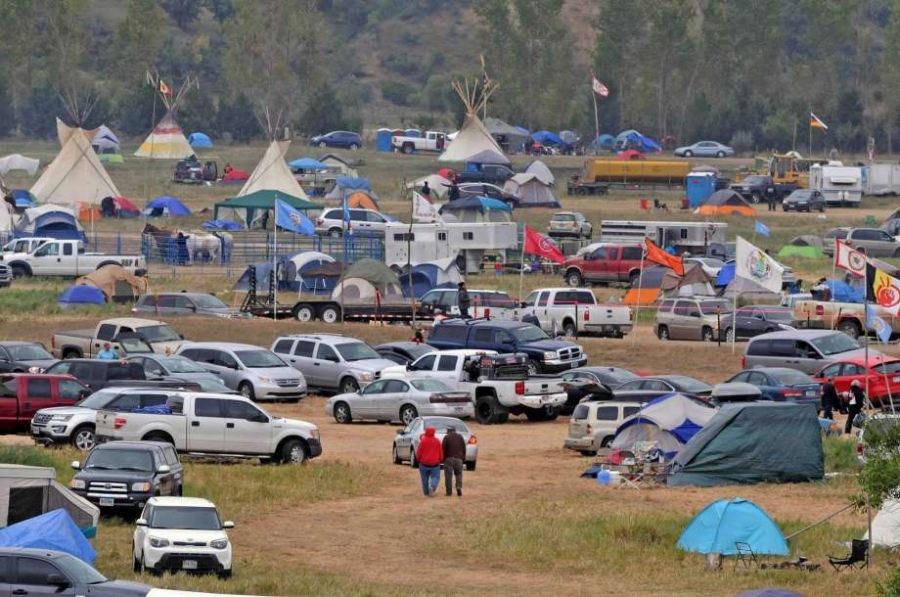
The Sacred Stones Overflow Camp is growing in size and number as more people arrive at the site along North Dakota Highway 1806 and across the Cannonball River from the Standing Rock Sioux Indian Reservation, Monday, Sept. 5, 2016 in Morton County, N.D. (Tom Stromme/The Bismarck Tribune via AP)
lessThe Sacred Stones Overflow Camp is growing in size and number as more people arrive at the site along North Dakota Highway 1806 and across the Cannonball River from the Standing Rock Sioux Indian Reservation,
... more
A line of protesters against the construction of the Dakota Access oil pipeline on the Standing Rock Reservation in North Dakota head to a unity rally on the west steps of the State Capitol late Thursday, Sept. 8, 2016, in Denver. Several hundred marchers walked from the four directions to the Capitol to take part in the rally against the oil pipeline.
lessA line of protesters against the construction of the Dakota Access oil pipeline on the Standing Rock Reservation in North Dakota head to a unity rally on the west steps of the State Capitol late Thursday, Sept.
... more
Sam Grant of the Omaha tribe addresses members of the Ponca, Santee, Winnebago and Omaha Tribes in Nebraska and Iowa along with others during a rally on Thursday, Sept. 8, 2016, in front of the Army Corps of Engineers offices in Omaha, Neb., to protest against the Dakota Access Pipeline in the Dakotas and Iowa. A judge is expected to rule Friday on whether to block construction of the pipeline that is supposed to pass close to the tribal reservation near the North Dakota-South Dakota border.
lessSam Grant of the Omaha tribe addresses members of the Ponca, Santee, Winnebago and Omaha Tribes in Nebraska and Iowa along with others during a rally on Thursday, Sept. 8, 2016, in front of the Army Corps of
... more
Attorney Jan Hasselman, representing Standing Rock Sioux Tribe, speaks to members of the media outside U.S. District Court in Washington, DC., Tuesday, Sept. 6, 2016, as members of the tribe had asked a federal judge to temporarily stop work on parts of the Dakota Access Pipeline to prevent the destruction of sacred and culturally significant sites near Lake Oahe.
lessAttorney Jan Hasselman, representing Standing Rock Sioux Tribe, speaks to members of the media outside U.S. District Court in Washington, DC., Tuesday, Sept. 6, 2016, as members of the tribe had asked a federal
... more
Tusweca Mendoza, 10, of Arlington, Va., originally from Pine Ridge, S.D., holds up a sign outside U.S. District Court in Washington, Tuesday, Sept. 6, 2016, as members of the Standing Rock Sioux Tribe have asked a federal judge to temporarily stop work on parts of the Dakota Access Pipeline to prevent the destruction of sacred and culturally significant sites near Lake Oahe.
lessTusweca Mendoza, 10, of Arlington, Va., originally from Pine Ridge, S.D., holds up a sign outside U.S. District Court in Washington, Tuesday, Sept. 6, 2016, as members of the Standing Rock Sioux Tribe have
... more
Attorney Jan Hasselman, representing Standing Rock Sioux Tribe, speaks to members of the media outside U.S. District Court in Washington, DC., Tuesday, Sept. 6, 2016, as members of the tribe asked a federal judge to temporarily stop work on parts of the Dakota Access Pipeline to prevent the destruction of sacred and culturally significant sites near Lake Oahe.
lessAttorney Jan Hasselman, representing Standing Rock Sioux Tribe, speaks to members of the media outside U.S. District Court in Washington, DC., Tuesday, Sept. 6, 2016, as members of the tribe asked a federal
... more
Attorney Jan Hasselman, left, representing Standing Rock Sioux Tribe, and Phillip Ellis, right, press secretary for EarthJustice, walk together before speaking to members of the media outside U.S. District Court in Washington, DC., Tuesday, Sept. 6, 2016, as members of the tribe had asked a federal judge to temporarily stop work on parts of the Dakota Access Pipeline to prevent the destruction of sacred and culturally significant sites near Lake Oahe.
lessAttorney Jan Hasselman, left, representing Standing Rock Sioux Tribe, and Phillip Ellis, right, press secretary for EarthJustice, walk together before speaking to members of the media outside U.S. District
... more
Heather Mendoza, center, with her sons Tusweca Mendoza, 10, right, and Omaka Nawicakincinjin Mendoza, 7, of Arlington, Va., originally from Pine Ridge, S.D., hold up a signs outside U.S. District Court in Washington, DC., Tuesday, Sept. 6, 2016, as members of the Standing Rock Sioux Tribe have asked a federal judge to temporarily stop work on parts of the Dakota Access Pipeline to prevent the destruction of sacred and culturally significant sites near Lake Oahe.
lessHeather Mendoza, center, with her sons Tusweca Mendoza, 10, right, and Omaka Nawicakincinjin Mendoza, 7, of Arlington, Va., originally from Pine Ridge, S.D., hold up a signs outside U.S. District Court in
... more
In this Aug. 26, 2016, photo, Standing Rock Sioux Chairman Dave Archambault II poses for a photo near Cannon Ball., N.D., on the Standing Rock Sioux Reservation overlooking an encampment where Native Americans from across North America have gathered to join his tribe's growing protest against a $3.8 billion four-state oil pipeline. About 30 people, including Archambault himself, have been arrested in recent weeks for interfering with construction of the Dakota Access pipeline.
lessIn this Aug. 26, 2016, photo, Standing Rock Sioux Chairman Dave Archambault II poses for a photo near Cannon Ball., N.D., on the Standing Rock Sioux Reservation overlooking an encampment where Native Americans
... more
In this Aug. 26, 2016, photo, Monte Lovejoy, a member of the Oglala Sioux tribe on South Dakota's Pine Ridge Indian Reservation, left, takes a photo with Standing Rock Sioux Chairman Dave Archambault II at Cannon Ball, N.D. About 30 people, including Archambault himself, have been arrested in recent weeks for interfering with construction of the Dakota Access pipeline.
lessIn this Aug. 26, 2016, photo, Monte Lovejoy, a member of the Oglala Sioux tribe on South Dakota's Pine Ridge Indian Reservation, left, takes a photo with Standing Rock Sioux Chairman Dave Archambault II at
... more
Wambli Johnson poses for photo at an oil pipeline protest near the Standing Rock Sioux reservation in southern North Dakota on Thursday, Aug. 25, 2016. The 11-year-old donated $150 to protest organizers that she earned by selling homemade laundry soap at northern Arizona's Black Mesa, on the Navajo Nation. ( AP Photo/James MacPherson)
lessWambli Johnson poses for photo at an oil pipeline protest near the Standing Rock Sioux reservation in southern North Dakota on Thursday, Aug. 25, 2016. The 11-year-old donated $150 to protest organizers that
... more
Joye Braun, an organizer of the Dakota Access oil pipeline opposition, poses for a photo at a protest near the Standing Rock Sioux reservation in southern North Dakota on Thursday, Aug. 25, 2016. Braun has been at the protest site since April and has vowed to remain until the project is killed.
lessJoye Braun, an organizer of the Dakota Access oil pipeline opposition, poses for a photo at a protest near the Standing Rock Sioux reservation in southern North Dakota on Thursday, Aug. 25, 2016. Braun has been
... more
Jon Don Ilone Reed, an Army veteran and member of South Dakota's Cheyenne River Sioux Tribe, poses for a photo at an oil pipeline protest near the Standing Rock Sioux reservation in southern North Dakota, Thursday, Aug. 25, 2016. Reed said he fought in Iraq and is now fighting "fighting for our children and our water."
lessJon Don Ilone Reed, an Army veteran and member of South Dakota's Cheyenne River Sioux Tribe, poses for a photo at an oil pipeline protest near the Standing Rock Sioux reservation in southern North Dakota,
... more
People protesting the construction on a four-state oil pipeline at a site in southern North Dakota gather at campground near the Standing Rock Sioux reservation on Thursday, Aug. 25, 2016. About 300 people were at the campsite where protesters from across the country and members of 60 tribes have gathered in opposition to the $3.8 billion Dakota Access pipeline that will pass through Iowa, Illinois, North Dakota and South Dakota.
lessPeople protesting the construction on a four-state oil pipeline at a site in southern North Dakota gather at campground near the Standing Rock Sioux reservation on Thursday, Aug. 25, 2016. About 300 people were
... more
Native Americans from different tribes play the drum during a rally outside US District Court in Washington, Wednesday, Aug. 24, 2016, in solidarity with the Standing Rock Sioux Tribe in their lawsuit against the Army Corps of Engineers to protect their water and land from the Dakota Access Pipeline. A federal judge in Washington considered a request by the Standing Rock Sioux for a temporary injunction against an oil pipeline under construction near their reservation straddling the North Dakota-South Dakota border.
lessNative Americans from different tribes play the drum during a rally outside US District Court in Washington, Wednesday, Aug. 24, 2016, in solidarity with the Standing Rock Sioux Tribe in their lawsuit against
... more
Actress Susan Sarandon speaks at a rally outside US District Court in Washington, Wednesday, Aug. 24, 2016, in solidarity with the Standing Rock Sioux Tribe in their lawsuit against the Army Corps of Engineers to protect their water and land from the Dakota Access Pipeline. A federal judge in Washington considered a request by the Standing Rock Sioux for a temporary injunction against an oil pipeline under construction near their reservation straddling the North Dakota-South Dakota border.
lessActress Susan Sarandon speaks at a rally outside US District Court in Washington, Wednesday, Aug. 24, 2016, in solidarity with the Standing Rock Sioux Tribe in their lawsuit against the Army Corps of Engineers
... more
Actresses Susan Sarandon, left, joins a rally outside US District Court in Washington, Wednesday, Aug. 24, 2016, in solidarity with the Standing Rock Sioux Tribe in their lawsuit against the Army Corps of Engineers to protect their water and land from the Dakota Access Pipeline. A federal judge in Washington considered a request by the Standing Rock Sioux for a temporary injunction against an oil pipeline under construction near their reservation straddling the North Dakota-South Dakota border.
lessActresses Susan Sarandon, left, joins a rally outside US District Court in Washington, Wednesday, Aug. 24, 2016, in solidarity with the Standing Rock Sioux Tribe in their lawsuit against the Army Corps of
... more
Native Americans from different tribes participate in a rally outside US District Court in Washington, Wednesday, Aug. 24, 2016, in solidarity with the Standing Rock Sioux Tribe in their lawsuit against the Army Corps of Engineers to protect their water and land from the Dakota Access Pipeline. A federal judge in Washington considered a request by the Standing Rock Sioux for a temporary injunction against an oil pipeline under construction near their reservation straddling the North Dakota-South Dakota border.
lessNative Americans from different tribes participate in a rally outside US District Court in Washington, Wednesday, Aug. 24, 2016, in solidarity with the Standing Rock Sioux Tribe in their lawsuit against the
... more
Actresses Shailene Woodley, fourth from right, and Susan Sarandon, second from right, and Standing Rock Sioux Tribe member Bobbi Jean Three Lakes, right, participate in a rally outside the US District Court in Washington, Wednesday, Aug. 24, 2016, in solidarity with the Standing Rock Sioux Tribe in their lawsuit against the Army Corps of Engineers to protect their water and land from the Dakota Access Pipeline. A federal judge in Washington considered a request by the Standing Rock Sioux for a temporary injunction against an oil pipeline under construction near their reservation straddling the North Dakota-South Dakota border.
lessActresses Shailene Woodley, fourth from right, and Susan Sarandon, second from right, and Standing Rock Sioux Tribe member Bobbi Jean Three Lakes, right, participate in a rally outside the US District Court in
... more
Members of the Lakota people, Timothy Swallow, right, his wife Karan, second from right, and their children Naimah, 8, and Tas, 6, sing the native spiritual song during a rally outside the US District Court in Washington, Wednesday, Aug. 24, 2016, in solidarity with the Standing Rock Sioux Tribe in their lawsuit against the Army Corps of Engineers to protect their water and land from the Dakota Access Pipeline. A federal judge in Washington considered a request by the Standing Rock Sioux for a temporary injunction against an oil pipeline under construction near their reservation straddling the North Dakota-South Dakota border. The Sioux are challenging the Army Corps of Engineers' decision to grant permits for the $3.8 billion pipeline that is intended to carry oil from North Dakota to Illinois.
lessMembers of the Lakota people, Timothy Swallow, right, his wife Karan, second from right, and their children Naimah, 8, and Tas, 6, sing the native spiritual song during a rally outside the US District Court in
... more
Alexis Stevens from Montgomery County, Md., joins a rally outside the US District Court in Washington, Wednesday, Aug. 24, 2016, in solidarity with the Standing Rock Sioux Tribe in their lawsuit against the Army Corps of Engineers to protect their water and land from the Dakota Access Pipeline. A federal judge in Washington considered a request by the Standing Rock Sioux for a temporary injunction against an oil pipeline under construction near their reservation straddling the North Dakota-South Dakota border.
lessAlexis Stevens from Montgomery County, Md., joins a rally outside the US District Court in Washington, Wednesday, Aug. 24, 2016, in solidarity with the Standing Rock Sioux Tribe in their lawsuit against the
... more
Grace Caisson Miller right, a member of the Mi'kmaq tribe, and Maureen Zieber of the Nanticoke Oneida tribe, left, both from Delaware, join a rally outside the US District Court in Washington, Wednesday, Aug. 24, 2016, in solidarity with the Standing Rock Sioux Tribe in their lawsuit against the Army Corps of Engineers to protect their water and land from the Dakota Access Pipeline. A federal judge in Washington considered a request by the Standing Rock Sioux for a temporary injunction against an oil pipeline under construction near their reservation straddling the North Dakota-South Dakota border.
lessGrace Caisson Miller right, a member of the Mi'kmaq tribe, and Maureen Zieber of the Nanticoke Oneida tribe, left, both from Delaware, join a rally outside the US District Court in Washington, Wednesday, Aug.
... more
Actresses Shailene Woodley, from third left, filmmaker Josh Fox, actress Susan Sarandon, second from right, and Standing Rock Sioux Tribe member Bobbi Jean Three Lakes, right, join a rally outside US District Court in Washington, Wednesday, Aug. 24, 2016, in solidarity with the Standing Rock Sioux Tribe in their lawsuit against the Army Corps of Engineers to protect their water and land from the Dakota Access Pipeline. A federal judge in Washington considered a request by the Standing Rock Sioux for a temporary injunction against an oil pipeline under construction near their reservation straddling the North Dakota-South Dakota border.
lessActresses Shailene Woodley, from third left, filmmaker Josh Fox, actress Susan Sarandon, second from right, and Standing Rock Sioux Tribe member Bobbi Jean Three Lakes, right, join a rally outside US District
... more
FILE - In this Aug. 12, 2016, file photo, Native Americans protest the Dakota Access oil pipeline near the Standing Rock Sioux reservation in southern North Dakota. Morton County Sheriff Kyle Kirchmeier said Thursday, Aug. 18, 2016, that the developers of a $3.8 billion, four-state oil pipeline have agreed to halt construction of the project in North Dakota until a federal court hearing next week in Washington, D.C. The Standing Rock Sioux Tribe is suing federal regulators for approving permits for the pipeline that will move oil from North Dakota to Illinois.
lessFILE - In this Aug. 12, 2016, file photo, Native Americans protest the Dakota Access oil pipeline near the Standing Rock Sioux reservation in southern North Dakota. Morton County Sheriff Kyle Kirchmeier said
... more
FILE - In this Aug. 12, 2016, file photo, Native Americans protest the Dakota Access oil pipeline near the Standing Rock Sioux reservation in southern North Dakota. Dakota Access, developers of a multi-billion, four-state oil pipeline, filed a federal lawsuit Monday, Aug. 15, 2016, against Standing Rock Sioux Tribal Chairman David Archambault II and other protesters asking a judge to order protesters in North Dakota to stop interfering with the project.
lessFILE - In this Aug. 12, 2016, file photo, Native Americans protest the Dakota Access oil pipeline near the Standing Rock Sioux reservation in southern North Dakota. Dakota Access, developers of a multi-billion,
... more
Up To Us founders actress Shailene Woodley, left, and filmaker Ann Kleinhenz were at the protest of the Dakota Access Pipeline on Thursday. The pipeline would start in North Dakota and pass through South Dakota and Iowa before ending in Illinois. Construction of the pipeline began this week just north of the Standing Rock Sioux reservation. Nearly 200 people came from across the country to join in the protest. (Tom Stromme/The Bismarck Tribune via AP)
lessUp To Us founders actress Shailene Woodley, left, and filmaker Ann Kleinhenz were at the protest of the Dakota Access Pipeline on Thursday. The pipeline would start in North Dakota and pass through South
... more
People against the Dakota Access Pipeline chant in opposition on Thursday, Aug. 11, 2016, at a site where a roadway was being constructed to begin the process of building the pipeline. The pipeline would start in North Dakota and pass through South Dakota and Iowa before ending in Illinois. Construction of the pipeline began this week just north of the Standing Rock Sioux reservation. (Tom Stromme/The Bismarck Tribune via AP)
lessPeople against the Dakota Access Pipeline chant in opposition on Thursday, Aug. 11, 2016, at a site where a roadway was being constructed to begin the process of building the pipeline. The pipeline would
... more
Native Americans protest the Dakota Access oil pipeline on Friday, Aug. 12, 2016 near the Standing Rock Sioux reservation in southern North Dakota. The Standing Rock Sioux Tribe went to court to try to block a $3.8 billion pipeline that's going in the ground fast to carry oil from North Dakota to Illinois. Now tribal members are trying to turn up the heat, with arrests in the pipeline construction zone near the 2.3-million acre reservation that straddles the North Dakota-South Dakota border. .
lessNative Americans protest the Dakota Access oil pipeline on Friday, Aug. 12, 2016 near the Standing Rock Sioux reservation in southern North Dakota. The Standing Rock Sioux Tribe went to court to try to block a
... more
Tribune Law enforcement arrested several people protesting the Dakota Access Pipeline on a newly constructed roadway to be used in building the pipeline Thursday, Aug. 11, 2016. The pipeline would start in North Dakota and pass through South Dakota and Iowa before ending in Illinois. Construction of the pipeline began this week just north of the Standing Rock Sioux reservation. Nearly 200 people came from across the country to join in the protest. (Tom Stromme/The Bismarck Tribune via AP)
lessTribune Law enforcement arrested several people protesting the Dakota Access Pipeline on a newly constructed roadway to be used in building the pipeline Thursday, Aug. 11, 2016. The pipeline would start in
... more
Actress Shailene Woodley, right, poses with a fan for a portrait at the protest rally against the Dakota Access Pipeline on Thursday, Aug 11, 2016 in Bismarck, N.D.. The rally was held along North Dakota Highway 1806 four miles north of the Cannonball River bordering the Standing Rock Sioux Indian Reservation. (Tom Stromme/The Bismarck Tribune via AP) MANDATORY CREDIT
lessActress Shailene Woodley, right, poses with a fan for a portrait at the protest rally against the Dakota Access Pipeline on Thursday, Aug 11, 2016 in Bismarck, N.D.. The rally was held along North Dakota
... more
Up To Us founders actress Shailene Woodley, left, and filmaker Ann Kleinhenz were at the protest of the Dakota Access Pipeline on Thursday. The pipeline would start in North Dakota and pass through South Dakota and Iowa before ending in Illinois. Construction of the pipeline began this week just north of the Standing Rock Sioux reservation. Nearly 200 people came from across the country to join in the protest. (Tom Stromme/The Bismarck Tribune via AP)
lessUp To Us founders actress Shailene Woodley, left, and filmaker Ann Kleinhenz were at the protest of the Dakota Access Pipeline on Thursday. The pipeline would start in North Dakota and pass through South
... more
North Dakota tribe's request to stop work on Texas company's pipeline denied
NEAR THE STANDING ROCK SIOUX RESERVATION, N.D. (AP) — The Standing Rock Sioux Tribe's attempt to halt construction of the four-state Dakota Access oil pipeline near their North Dakota reservation, a cause that has drawn thousands to join a protest, was denied Friday by a federal judge.
The tribe had challenged the Army Corps of Engineers' decision to grant permits at more than 200 water crossings for Dallas-based Energy Transfer Partners' $3.8 billion pipeline, saying that the project violates several federal laws, including the National Historic Preservation Act, and will harm water supplies. The tribe also says ancient sacred sites have been disturbed during construction.
U.S. District Judge James Boasberg in Washington denied the tribe's request for a temporary injunction in a 58-page opinion. A status conference is scheduled for Sept. 16.
The ruling said that "this Court does not lightly countenance any depredation of lands that hold significance to the Standing Rock Sioux" and that, given the federal government's history with the tribe, "the Court scrutinizes the permitting process here with particular care. Having done so, the Court must nonetheless conclude that the Tribe has not demonstrated that an injunction is warranted here."
Attorney Jan Hasselman with environmental group Earthjustice, who filed the lawsuit in July on behalf of the tribe, said in the days before the ruling that it'll be challenged.
"We will have to pursue our options with an appeal and hope that construction isn't completed while that (appeal) process is going forward," he said. "We will continue to pursue vindication of the tribe's lawful rights even if the pipeline is complete."
Tribal historian LaDonna Brave Bull Allard said after the ruling that it gives her "a great amount of grief. My heart is hurting, but we will continue to stand, and we will look for other legal recourses." She also said the protest will continue.
Energy Transfer Partners officials didn't return The Associated Press' phone calls or emails seeking comment.
The 1,172-mile project will carry nearly a half-million barrels of crude oil daily from North Dakota's oil fields through South Dakota and Iowa to an existing pipeline in Patoka, Illinois.
Thousands gathered Friday at the protest over the pipeline, which will cross the Missouri River near the Standing Rock Sioux reservation in southern North Dakota. Judith LeBlanc, a member of the Caddo Nation in Oklahoma and director of the New York-based Native Organizers Alliance, said before the decision that she expected the protest to remain peaceful.
"There's never been a coming together of tribes like this," she said of Friday's gathering of Native Americans, which she estimated could be the largest in a century. People came from as far as New York and Alaska, some bringing their families and children, and hundreds of tribal flags dotted the camp, along with American flags flown upside-down in protest.
A rally against the Dakota Access pipeline is scheduled for Friday afternoon at the North Dakota Capitol, and many of those gathered at the protest site are expected to make the about 45-mile trek.
State authorities announced this week that law enforcement officers from across the state were being mobilized at the protest site, some National Guard members would work security at traffic checkpoints and another 100 would be on standby. The Great Plains Tribal Chairman's Association has asked the federal Justice Department to send monitors to the site because it said racial profiling is occurring.
Nearly 40 people have been arrested since the protest began in April, including tribal chairman Dave Archambault II, though none stemmed from Saturday's confrontation between protesters and construction workers. Tribal officials said workers allegedly bulldozed sites on private land that Hasselman said in court documents was "of great historic and cultural significance." Energy Transfer Partners denied the allegations.
Four private security guards and two guard dogs were injured, officials said, while a tribal spokesman said six people — including a child — were bitten by the dogs and at least 30 people were pepper-sprayed. The state's Private Investigation and Security Board received complaints about the use of dogs and will look into whether the private security personnel at the site are properly registered and licensed, board attorney Monte Rogneby said Friday, adding that he would not name the firms.
On Thursday, North Dakota's archaeologist said that piece of private land was not previously surveyed by the state would be surveyed next week and that if artifacts are found, pipeline work still could cease.
The company plans to have the pipeline completed this year. In court papers, ETP said stopping the project would cost it $1.4 billion the first year, mostly due to lost revenue in hauling crude.
"Investor appetite for the project could shift and financing may no longer be available," the company said. "Construction of the entire project would cease and the project itself would be jeopardized."
___
This story has been corrected to show that the opinion is 58 pages long, not one page with no explanation.
Original Source