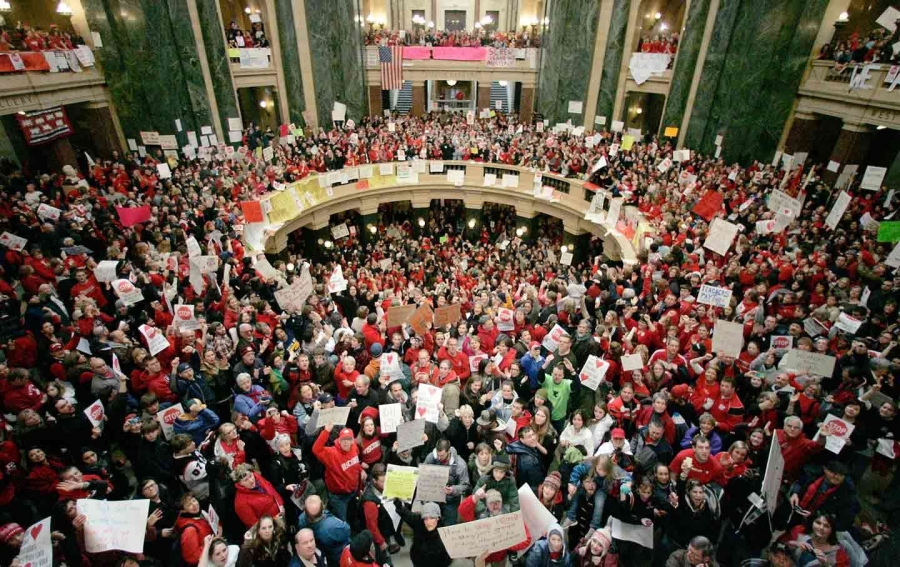
in Madison, Wisconsin, on February 18, 2011, for the fourth day in a row. (AP Photo / Craig Schreiner)
Alex Hanna was in Egypt watching a revolution unfold when she found out that the governor of her state back home was proposing to eliminate her union rights. Hanna was co-president of the Teaching Assistants Association (TAA) and a graduate student in sociology at the University of Wisconsin at Madison when Scott Walker was elected governor; she and others within the union and its parent union, the American Federation of Teachers (AFT) of Wisconsin, had been concerned that the Republican, swept into office as part of the Tea Party wave of 2010, would be bad for union workers. But they hadn’t expected anything like Act 10.
This article is an excerpt from Necessary Trouble: America In Revolt by Sarah Jaffe. Copyright © 2016. Available from Nation Books, an imprint of Perseus Books, LLC, a subsidiary of Hachette Book Group, Inc.
The act that Walker proposed as a “budget repair” bill on Valentine’s Day, February 14, 2011, mirrored what was being called “austerity” in Europe, purporting to balance the state budget with cuts to salaries and benefits for public employees as well as cuts to services. The cuts were to be expected in the still severe economic downturn, but few had predicted that the governor would eliminate or severely curtail the rights of most public employees to collectively bargain. What was really shocking was the way austerity seemed to serve a kind of disciplinary function; the moralistic language Walker used to describe the bill presented this belt-tightening not only as a response to the crisis but as a punishment, and the punishment was aimed at the victims of the crash rather than its perpetrators. Hanna and the TAA saw the bill as a naked attack on their rights in the workplace by a governor who had run promising to bring jobs back to their struggling state.
The TAA had already planned a rally for Valentine’s Day, in a preemptive strike against likely cuts to the university, and Hanna was deluged with emails asking her to come home. She was observing the popular revolution that had begun in Egypt in the winter of 2011, part of what came to be known as the Arab Spring. But the attacks on the union and the university were serious enough that she returned just in time for the February 14 action. The TAA led a crowd of marchers up State Street from the university campus to deliver a thousand valentines protesting Act 10 to Walker at the Capitol. It was an impressive showing, but marches were common enough in Madison that few expected this one to be different. Jenni Dye, a lawyer based in Madison, was downtown eating brunch and saw the protesters. “I thought, ‘Oh look, another Madison protest.’”
The next day the Joint Finance Committee of the legislature held a hearing on Act 10. The TAA and other union protesters had planned a “people’s filibuster” of the bill, lining up hundreds of people to speak against it and extending the comment period all day and all night. The repeal of collective bargaining rights, they argued, had nothing to do with “repairing” holes in the budget; freezing their wages was one thing, and even increasing the amounts they had to contribute to their pensions and health insurance could at least be vaguely connected to a need for funds, but getting rid of their right to negotiate for a raise higher than the cost of living when the economy improved was very different and had little to do with the current budget problems. People were incensed. “We had people stuffed in the overflow room of the Capitol, people in line, and the unions were agitating outside,” Hanna said. As the comments stretched on into the evening, the protesters created the Defend Wisconsin Twitter account to send out updates. At the beginning of the day, Hanna said, they’d been told that testimony would continue until everyone had been heard, but sometime after midnight the legislators cut off the speakers, announcing they’d heard enough.
Most Popular
“We decided we were just going to stay,” Hanna said. She and her colleagues sent out messages via Twitter and Facebook, calling for people to join them at the Capitol and to bring sleeping bags. The TAA members invited their students, and they camped out in the Capitol rotunda. At 5:00 a.m., Hanna looked at the person next to her and said, “I guess this is happening!”
Protesters and pundits began to compare the Wisconsin protest to Tahrir Square. The comparisons to Egypt seemed overblown to Hanna at first, but as the occupation went on, similar structures to those in Tahrir Square began to take shape, structures that were later echoed and expanded at Occupy Wall Street. Hanna had found the protests in Tahrir Square vibrant, almost carnivalesque, unlike anything she’d seen before. “It felt very safe, very communal,” she said. There were people selling or giving out food, people giving speeches, people camped out. In the Wisconsin Capitol, too, were medics, food distribution, action planning, all of which seemed to arise spontaneously as people took it upon themselves to make things happen and provide services that were being slashed by the state. The space itself provided a concrete alternative to the austerity the government was pushing. Although organizations like the TAA, the AFT, and other labor unions with elected leadership were present, and helped build the occupation, inside the space things were open and horizontal. Like the occupation of Tahrir Square, the Wisconsin occupation, and later Occupy, held a space that was politically significant—the Capitol building, the “people’s house,” a symbol of Wisconsin’s famously open and transparent governance.
* * *
For Jenni Dye, who was the daughter of a Wisconsin teacher but not a union member herself, it was the process by which Act 10 was pushed forward as much as the content of the bill itself that motivated her to join the protests. “Part of it was about standing up for the middle class, for workers, and for the everyday people in Wisconsin that are your friends and neighbors,” she said. “What was happening was just not the way that we did business in Wisconsin. We didn’t rush huge policy changes through. We didn’t meet in the middle of the night and shut out public testimony.” She felt that what was happening was profoundly undemocratic, and it roused her sense of solidarity—it was unacceptable that Walker was blaming the rough economy on her family and friends.
GET A DIGITAL SUBSCRIPTION FOR JUST $9.50! Subscribe
In cities and towns across the country, many of the people who watched the Wisconsin protests unfold had the same reaction Dye did. Union members and organizers, of course, were roused to defend their institutions, but it was the power grab, the high-handed way Walker dismissed the protests, that made people realize that something more than a march was needed. Brett Banditelli, at the time the producer for the Rick Smith Show, a Pennsylvania-based labor radio show, was following the protests via social media. He began to reach out to fund-raisers to see if he could get money to take the show to Madison to cover the protests. At first, funders thought it was simply a local story, but then Ohio’s governor proposed a similar bill—one that didn’t carve out firefighters and police officers, as Walker’s had, but took rights from all, inspiring unlikely coalitions between cops and leftists.
When Banditelli arrived at the Wisconsin Capitol with Rick Smith, the first thing he saw was a massive sign made out of a bedsheet fluttering from a balcony high above the rotunda floor. It read “Kill the Bill!” The occupation had been going for a week by then, and the Capitol was thronged with people bundled up for Wisconsin winter, many of them in red shirts with a blue fist in the shape of the state on it. Handwritten “Kill the Bill!” signs waved in the crowd and hung next to professionally printed union signs—not just from the public-sector unions under threat, the AFT, the Service Employees International Union, and the American Federation of State, County and Municipal Employees (AFSCME), but also from the once-powerful industrial unions like the United Steelworkers. Banditelli and Smith were far from the only people who had driven all night to join the protests: labor had answered the call. A group of firefighters, who had been excluded from the cuts in Walker’s bill, marched through the Capitol playing the bagpipes, led by their young, charismatic leader Mahlon Mitchell. Three levels of protesters on the rotunda joined in a sing-along of “Do You Hear the People Sing?” from the musical Les Misérables.
The sign Jenni Dye remembered best was one she spotted on an outdoor march one snowy day. The man holding it “looked like the ultimate Packer fan,” she said. “He had this big bushy Wisconsin beard and a winter hat on and his jacket was green and his sign said, ‘All the faith that I have lost in the government I have found in the people.’” For her, that was the story of the protest.
* * *
As the protests continued, Walker doubled down, announcing a budget for the next two years that the local paper said “remold[ed] Wisconsin government at every level.” It slashed roughly $1 billion from public schools, laid off 1,200 people, sliced 11 percent of the University of Wisconsin’s budget—and lowered corporate taxes even more, on top of $100 million in tax cuts the governor and his legislative cronies had already passed. Cutting taxes for the rich while cutting rights for workers seemed, to the protesters, to be an obvious example of what the Chicago Teachers Union (CTU) would later call “being broke on purpose”—eliminating a source of revenue in order to justify cuts that those in power already wanted to make.
We didn’t always hear what was happening in the United States referred to as “austerity”; in Europe, the policy had a name and often brutal enforcement, while in the United States the metaphors of “belt-tightening” and “spending within our means” were more common. But the results were the same. The Obama administration proposed an economic stimulus plan early on, but it met with resistance in Congress from budget hawks squawking about deficits; the stimulus that did get passed wound up being, according to several prominent economists, too small to succeed. When it appeared that the Democrats in power weren’t doing enough to turn the economy around, the Republicans rode a Tea Party wave to victory in the 2010 midterm elections, sweeping Scott Walker, John Kasich, and Chris Christie, among others, into governor’s offices. They won largely because of their promises to do what the Democrats seemingly couldn’t or wouldn’t do: put people back to work.
What the Tea Party actually wanted, though, was not very clear. While grassroots activists opposed the bank bailouts and stimulus spending, which they saw as handouts to the undeserving, researchers and pollsters found that many Tea Partiers had no problem with public spending on programs like Social Security and Medicare, which they felt were “earned.” They were not, despite the policies attached to the Tea Party brand, lining up to demand austerity cutbacks to popular programs; nor were they clamoring to dismantle labor unions once and for all, as so many Tea Party governors seemed bent on doing. Tea Partiers, for the most part, were even willing to support tax increases on the wealthy to keep Social Security functioning. Nobody campaigned on wage cuts, budget cuts, and the removal of union rights.
Meanwhile, the wealthy conservatives who adopted the Tea Party name and poured money into funding events were spending lavishly on candidates. The Kochs, who supported Walker and many others, did have a particular set of policies in mind, as did many of the other rich ideologues whose money helped Republicans take the US House of Representatives and several statehouses. Austerity, to them, was less about cutting spending for its own sake, and more about cutting programs to which they were politically opposed while consolidating their own power. It often included selling off public resources and utilities to private companies and pumping public dollars, in some cases, to the very people who had created the economic crisis in the first place. A big barrier to that consolidation of power had always been the presence of labor unions, which despite shrinking clout still served as a force in the workplace and in politics for working people. The post–crisis shock moment seemed, to the powerful, to be the perfect time to wipe out unions for good.
Politicians argued that the cuts that came in Wisconsin, Ohio, and other states in 2011 were necessary in order to bring about economic stability, but those cuts also revealed a host of ideological preferences. The financial crisis, not the salaries of teachers and social workers, had blown the holes in state budgets, but Walker and others blamed government spending, and particularly those public workers. They pointed fingers at bloated pensions, when in fact pension funds were missing cash thanks to the bankers who had caused the crisis: Ohio’s pension fund had bought mortgage-backed securities from Lehman Brothers, where John Kasich was an investment banker from 2001 to 2008, and lost tens of millions. Kasich became governor of the state in 2011 and pushed forward his own attack on collective-bargaining rights. The crisis was a great opportunity to slice away the budgets that politicians aligned with the wealthy and powerful already opposed and take aim at the protections that workers had spent decades solidifying. The Wisconsin uprising was the awakening of a sense ... that labor unions are still a counterweight to the power of big money.
The term “austeritarian” was coined by Greek activists, a portmanteau used to point out that austerity policies were often imposed by authoritarian means, on populations still reeling from the shock of a collapse. In Wisconsin, the attack on collective bargaining was the epitome of austeritarianism: Though Walker argued that Act 10 would save the state billions, it is hard to argue that collective bargaining itself had a price tag the same way health insurance or a pension plan did. What the law did was to change the relations of power between public employees and their employer.
In Wisconsin, people from inside and outside of the labor movement stood up for something more than just the rights of nurses and teachers to negotiate their salaries. The Wisconsin uprising was the awakening of a sense, long dormant, that labor unions are still a counterweight to the power of big money in American life.
“Without the ability to organize, to have some group with some organized voice to say, ‘No, this is wrong,’ then [decent health care and working conditions] can go away, not just for union members but for everybody,” Cindy Clark said.
Wisconsinites stood up for the idea of working people coming together to counterbalance the power of the billionaire class.
Sarah Jaffe Necessary Trouble: Americans in Revolt (Nation Books).
To submit a correction for our consideration, click here.
For Reprints and Permissions, click here.
Sort comments By:
Chronological Order Most Liked
Julie Stroeve says:
September 26, 2016 at 3:06 pm
Sarah describes what I call The Shock Doctrine (all credit to Naomi Klein). Systematic seizure by the rich and powerful of macro-economic, political, and environmental opportunities. This idea that work-a-day workers don't deserve livable wages and secure health and retirement plans. That Walker was not impeached is simply beyond me. Where are the jobs, Scottie? They just didn't trickle down. Wisconsinites won't be rolled next time.
(1 ) (0 )
Walter Pewen says:
September 26, 2016 at 10:14 pm
But they may be. This stuff has been going on since the 1980's actually, frankly I'm amazed how so many Americans rolled over for it then. Many during that period just felt it was impossible to take on the Reagan media machine and went to sleep. Unfortunately, this phenomena just keeps happening on a more amplified level than ever. People get tired, and another one comes along and takes hostages. Maybe not again in Wisconsin, but the fact that it even has happened now in a state with such a strong progressive tradition should give pause. This is very scary, in large part because it is happening in the United States, not say a Balkan state for example.
(1 ) (0 )
Alan Backman says:
September 24, 2016 at 3:05 pm
What a bunch of liberal BS. Unions are monopolies - pure and simple. Sure, they provide improved compensation and benefits. That's not an argument. It's why people seek monopolies - because beneficiaries can get extra money when consumers have no choice. But it results in an economic loss because the company demands less labor at a higher price than otherwise. In a competitive market, these higher costs cannot be passed on resulting in a reduced ability to win marketshare and decline of the business. See the Big 3 Auto's, Steel, etc. And the only area where such union costs do not lead to insolvency in in the public sector - where the organizations generally don't have competition - e.g. police, fire, etc. This is why teachers hate charters so much - because they provide (for the first time) real competition.
(6 ) (7 )
Walter Pewen says:
September 25, 2016 at 7:04 pm
Before addressing the essence of your post, I'll ask you-what do you actually KNOW about charters? Here's a hint. Nationwide, after 25 years, the numbers just are not that different, with exceptions, for charter schools. I'd suggest reading up on, you may be quite surprised.
(3 ) (2 )
Phil Johnson says:
September 23, 2016 at 3:11 pm
I got one. Read his 1990 book, "Trump".
(9 ) (3 )
Charles Jacoby says:
September 23, 2016 at 8:30 pm
Ms. Jaffe provides clarity to what took place in Wisconsin, the likes of which I've never read before. Excellent work.
Going back a bit further, however, what is current union membership, in particular those that do not consist of workers in the public sector? I didn't realize the United Steel Workers was still extent. America doesn't make steel anymore, relative to the past.
Hardly any workers in the private sector are unionized. It's difficult to see how millions of workers who specialize could be unionized. I say that as an office worker for a small insurance agency. Has there ever been, say, a United Secretaries union that crosses big and small businesses, and that could collectively bargain at all? I don't know the answer, but I do know that the vast majority of American labor is not organized as a counter to the millionaires and billionaires who exploit those same workers every day of their working lives. The most they can do is ask for a raise--as individuals.
Somehow the concept of "union" has to be expanded to include more than those who work together in large factories or who work for local and state government, a single entity. The Teamsters probably provide the best model, though I don't know how that same kind of organizing could be applied to secretaries and file clerks, and fast-food workers, low-wage earners in general. Somehow it's got to be done.
(9 ) (2 )
Walter Pewen says:
September 25, 2016 at 9:48 pm
Those are very good points. When I was younger it perturbed me that say, as an office worker, I was simply glossed over in the discussion. There have always been "givens" that clerical, retail, etc. shouldn't even ask about it. Somewhat arrogant, in a way.
(1 ) (1 )
Charles Jacoby says:
September 23, 2016 at 8:13 pm
Hear, hear.
(1 ) (2 )
Today 10:55 am Yesterday 3:44 pm
“AN INDISPENSABLE VOICE IN OUR POLITICAL DIALOGUE.” —ELIZABETH WARREN
Original Source